Clear, honest guides to what you've earned — what each benefit is, who
qualifies, and how to claim it. When you're ready, we send you straight
to VA.gov.
The Benefits Brief turns public information from VA.gov into short, plain-language guides about U.S. veterans' benefits — so you can understand the basics quickly, then go to the official source to apply.
What this site does
We explain how things work: who a benefit is for, the general steps to apply, and what you'll typically need. Each guide is meant to be read in a few minutes and points you to the exact VA.gov page for the details.
What this site does not do
We don't process claims, take applications, or handle your records.
We don't publish specific dollar amounts, rating tables, income limits, or deadlines — those change, so we link you to VA.gov for current figures.
We're not a substitute for advice from the VA or an accredited VSO.
Not affiliated with the government
How content is sourced and reviewed
Every guide summarizes a specific page on VA.gov and links back to it. Each one shows a "Reviewed {Month Year}" date so you can see how current it is. If something looks out of date, trust VA.gov over us.
Getting official help
For anything specific to your situation, contact the VA through VA.gov, or work with a Veterans Service Organization (VSO). VSOs are accredited to help with benefits and claims, and their help is free.
All Guides
Plain-language explanations, each based on a specific VA.gov page. Pick one below, or scroll through.
VA disability compensation is a monthly, tax-free payment for veterans with a health condition connected to their military service. Start here to understand the basics before you file.
Start here. If you have a health condition that's linked to your time in the military, you may be able to get a monthly payment from the VA called disability compensation. This guide explains what it is and how it works in plain terms.
Who It's For
VA disability compensation is for veterans whose illness or injury is connected to their service — what the VA calls a "service-connected" condition. This can include:
Conditions that began or got worse during active duty.
Conditions that appeared later but are linked to your service (for example, certain illnesses tied to toxic exposure).
Conditions caused or worsened by another service-connected condition.
You don't have to have been injured in combat. Many physical and mental health conditions can qualify.
How the Payment Works
The VA assigns your condition a disability rating — a percentage that reflects how much it affects you. Your rating determines your monthly payment amount. If you have a spouse, children, or dependent parents, your payment may be higher.
The dollar amounts and the rating tables change over time, so we don't list them here. [Verify current figures on VA.gov] for the exact rates.
The payment is tax-free, and you generally don't lose it by working — though some related benefits do depend on your situation.
What You'll Generally Need
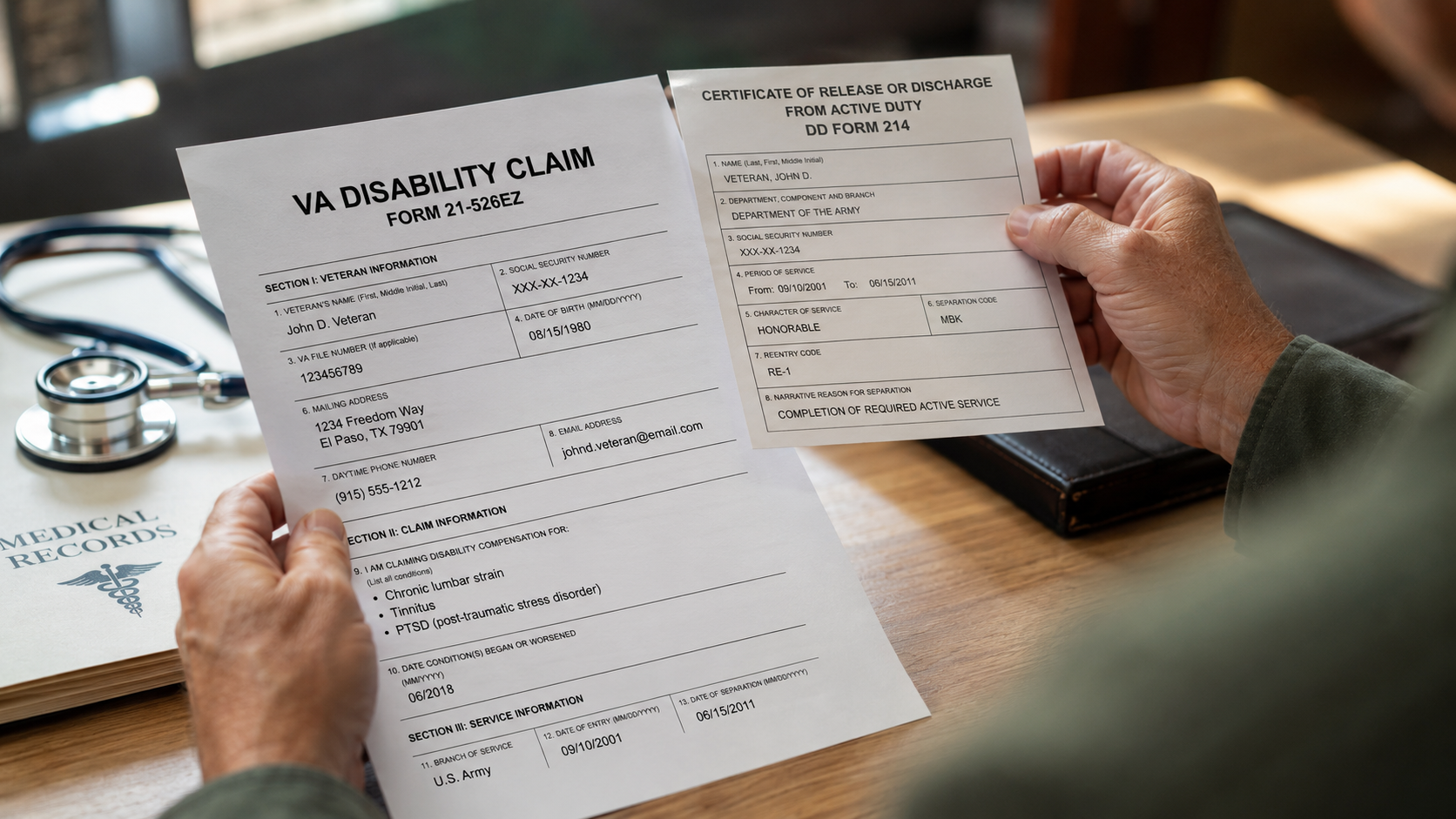
Your discharge or separation papers (such as a DD214).
Medical records showing your diagnosis and how the condition affects you.
Any evidence linking the condition to your service.
You can file a VA disability claim online, by mail, in person, or with help from an accredited representative. Here's the path and what to have ready.
Filing a disability claim is how you ask the VA to recognize that a health condition is connected to your service and to pay compensation for it. This guide walks through the steps at a high level.
Before You Start
Discharge papers (such as a DD214).
Medical evidence — VA or private records showing your diagnosis and its effect on you.
Supporting statements — from you, family, or fellow service members.
Your Ways to File
Online through your VA.gov account — usually the fastest.
By mail using the VA's application form.
In person at a VA regional office.
With help from an accredited VSO or representative.
"Fully Developed" vs. Standard Claims
The VA offers a faster track when you submit all your evidence at the same time as your application. The specific programs and timelines can change — [Verify current figures on VA.gov] for what's available now.
The PACT Act expanded VA health care and benefits for veterans exposed to burn pits, Agent Orange, and other toxic substances. Here's what it means for you.
The PACT Act is a law that expanded VA health care and disability benefits for veterans exposed to toxic substances during their service. If you served near burn pits, were exposed to Agent Orange, or encountered other hazards, this may affect you.
What the PACT Act Changed
Added conditions the VA now considers connected to toxic exposure — so you may not have to prove the link yourself for those conditions.
Expanded who qualifies for VA health care based on exposure.
Extended benefits to more eras and locations of service.
The specific list of conditions and qualifying service can change as the law is implemented, so check the current details on VA.gov rather than relying on a fixed list.
What You Can Do Now
Sign up for a toxic exposure screening through the VA.
Consider filing a claim if you have a condition that may be related.
Enroll in VA health care if you're newly eligible.
There's no fixed deadline to apply, but filing sooner can affect when your benefits start. [Verify current figures on VA.gov] for any dates that apply to back pay.
Most veterans who served on active duty and didn't receive a dishonorable discharge can apply for VA health care. Your specific benefits depend on a few factors.
VA health care can cover checkups, specialist care, mental health support, prescriptions, and more. This guide explains who can apply and what affects your benefits.
The Basic Rule
In general, you may qualify if you served in active military service and were separated under any condition other than dishonorable. Length-of-service requirements can apply depending on when and how you served. Because the rules have exceptions, the safest move is to apply and let the VA determine your eligibility.
What Affects Your Benefits
When you enroll, the VA places you in a priority group. This affects your costs and how soon you can get care. Factors include your disability rating, your income, and special circumstances such as former POW status or toxic exposure.
We don't list income thresholds or priority-group details here because they change. [Verify current figures on VA.gov] for the current numbers.
The Post-9/11 GI Bill can help pay for college, training, and related costs for those who served after September 10, 2001. Here's what it covers and how to use it.
The Post-9/11 GI Bill helps veterans and some family members pay for education and training. This guide covers the basics so you know what to expect.
Who It's For
You may qualify if you served on active duty for a qualifying period after September 10, 2001. The amount of benefit you get often depends on how long you served. In some cases, you can transfer unused benefits to a spouse or child.
What It Can Help Pay For
Tuition and fees (paid toward your school).
A monthly housing allowance while you're enrolled.
A stipend for books and supplies.
Exact payment amounts and the housing allowance vary by program and location — [Verify current figures on VA.gov].
A VA-backed home loan can help you buy, build, or refinance a home — often with no down payment and no private mortgage insurance. Here's how it works.
A VA-backed home loan is a mortgage from a private lender (a bank or credit union) that the VA partially guarantees. That guarantee makes lenders more comfortable offering favorable terms. This guide explains the basics.
What Makes a VA Loan Different
No down payment in many cases.
No private mortgage insurance (PMI).
Competitive interest rates and limited closing costs.
There's usually a one-time VA funding fee, though some veterans are exempt. The fee amount depends on your situation — [Verify current figures on VA.gov].
Who Can Qualify
Eligibility is based on your service history, and you'll need a Certificate of Eligibility (COE) to show the lender you qualify. You'll also need to meet the lender's credit and income requirements — the VA backs the loan, but the lender still decides whether to approve you.
How the Process Works
Get your COE (you can often request it online).
Find a lender that offers VA loans and get pre-approved.
Shop for a home and make an offer.
Go through appraisal and underwriting, then close.
The VA offers health care, education, and financial support to some spouses, children, caregivers, and survivors of veterans. Here's an overview of what's out there.
Some VA benefits extend to a veteran's family members, caregivers, and survivors. This guide gives you a map of the main areas so you know what to look into.
Who May Be Eligible
Spouses and surviving spouses.
Dependent children.
Caregivers of veterans with serious conditions.
Survivors of veterans who died in service or from a service-connected cause.
Main Types of Support
Health care. Certain spouses, children, and survivors may qualify for VA-related health coverage programs.
Education. Some dependents and survivors can get help paying for school.
Financial support for survivors. The VA offers monthly payments to some survivors when a veteran's death is connected to their service. Amounts and rules change, so [Verify current figures on VA.gov].
Caregiver support. Programs exist to support family caregivers, which may include training, resources, and a monthly stipend in some cases.
VA pension is a needs-based monthly payment for some wartime veterans with limited income who are older or have a disability. It's different from disability compensation.
VA pension is a monthly payment that helps wartime veterans with limited income. It's based on financial need, not on a service-connected condition — which makes it different from disability compensation.
Who It's For
In general, you may qualify if you served during a recognized wartime period, meet a service-length requirement, and have income and assets below the VA's limits. It often applies to veterans who are older or who have a disability.
The income limits, asset limits, and service requirements change and have specific rules — [Verify current figures on VA.gov].
Extra Help: Aid and Attendance
If you need help with daily activities or are housebound, you may qualify for an added amount on top of the basic pension. This is sometimes called Aid and Attendance.
What You'll Generally Need
Your discharge papers (such as a DD214).
Financial information about your income and assets.
Medical information, if you're applying based on a disability or for Aid and Attendance.
The VA offers several life insurance programs for service members, veterans, and families. Which one fits depends on your service status and health.
Life insurance pays money to the people you choose if you pass away. The VA runs a few different programs, and the right one depends on whether you're serving, recently separated, or a veteran with a service-connected condition.
The Main Programs
Coverage while serving — group life insurance for active service members.
Coverage after you separate — a way to convert or continue coverage as a veteran.
Coverage tied to a service-connected disability — options for veterans who qualify.
Family coverage — some programs can cover a spouse and children.
Premiums, coverage amounts, and enrollment windows vary by program — [Verify current figures on VA.gov].
Why Timing Matters
Some programs have deadlines after you separate or after a life event. If you're leaving the service or your situation is changing, it's worth checking your options sooner rather than later.
The VA offers employment help, retraining, and career services for veterans — including extra support if a service-connected disability affects the work you can do.
If you're looking for work, changing careers, or need new skills, the VA has several programs to help. This guide gives you a map of the main ones.
What's Available
Career counseling to help you plan your next step.
Help finding a job — resume support, job search tools, and connections to employers.
Retraining and skills programs for in-demand fields.
Veteran Readiness and Employment (VR&E) — extra support if a service-connected disability affects your ability to work.
Veteran Readiness and Employment
VR&E (sometimes called "Chapter 31") can help with training, education, and services aimed at getting and keeping a suitable job. Eligibility is tied to a service-connected disability and how it affects your employment. The specifics can change — [Verify current figures on VA.gov].
Compensation for service-connected conditions, and how to file a claim.
Health care
Eligibility, enrolling, and what VA health care covers.
Education
GI Bill and other ways VA helps pay for school and training.
Housing
VA-backed home loans and housing assistance.
Family, caregivers & survivors
Benefits for spouses, dependents, caregivers, and survivors.
Pension
Needs-based payments for wartime veterans and survivors with limited income.
Life insurance
VA life insurance options for service members, veterans, and families.
Careers
Job training, employment help, and career support.
The Warrior Allegiance Podcast
VA Disability Claims, Decoded.
By Warrior Allegiance·4 episodes·Updated Jul 2026
Straight-talk episodes on how VA ratings, C&P exams, denials, and secondary claims actually work — from the team that reads the rulebook for a living. Pick a fight you can win.
Can I file for sleep apnea years after I separate?
Often, yes. If a service-connected condition (like PTSD) helped cause or worsen it, sleep apnea can be claimed as a secondary condition — the key is a solid medical link, not the calendar. Hear it in Episode 3 →
What actually happens at a C&P exam?
It's a structured evaluation the rater leans on heavily. What matters most is describing your condition on its worst days, not powering through like you were trained to. Hear it in Episode 4 →
Is a denial really the end of the road?
No. A denial letter is a map, not a stop sign — the rulebook gives you several lanes to challenge a "no," and many claims turn around on appeal. Hear it in Episode 2 →
Why am I stuck at 90%?
VA "combined" math isn't simple addition, which is why 90% is the hardest wall to cross. There are two legitimate routes to 100% — we walk both. Hear it in Episode 1 →
ArmyMarine CorpsNavyAir ForceCoast GuardSpace Force
About the show
We read the VA rulebook so you don't have to.
Every episode takes one hard question veterans actually ask us — how do I get past 90%, what really happens inside a C&P exam, how do I turn a denial around — and walks the regulation, the math, and the move in plain English. No hype, no promises. Just how the system actually works, so you can walk into your claim knowing the rules.
Plain-language, every single episode
Built on the actual VA regulations
Hosted by the Warrior Allegiance team
Why veterans trust Warrior Allegiance
People who've been where you are.
A real veteran community
Built right alongside the veterans it serves — not a call center.
Our veteran promise
Veteran-owned and veteran-run. We put in the work to earn your trust.
Guidance you can trust
Honest, plain-language help from people who understand the fight.
Questions about the show
Who makes the Warrior Allegiance Podcast?
It's hosted by the team at Warrior Allegiance, a veteran-focused claims consultancy. Each episode reads through the rules in plain language so you understand how a benefit works before you file.
Is this official VA information?
No. Warrior Allegiance is a private consultancy and is not VA-accredited or affiliated with the U.S. Department of Veterans Affairs. The episodes explain how things generally work — for the official rules, figures, and to apply, go to VA.gov.
Do you promise a specific rating or outcome?
No. Every claim is different and results vary. We share how the process works and what tends to help — we don't guarantee a percentage, an approval, or a timeline.
Where can I listen?
The show — Warrior Allegiance: VA Disability Claims, Decoded — is on Spotify, Apple Podcasts, and Amazon Music. Use the "Listen on" links on any episode above, or the buttons at the top of the page.
I'm in crisis — where do I go?
Please reach the Veterans Crisis Line right now: dial 988, then press 1, or visit veteranscrisisline.net. It's free, confidential, and available 24/7.
About The Benefits Brief
The Benefits Brief turns public information from VA.gov into short, plain-language guides about U.S. veterans' benefits — so you can understand the basics quickly, then go to the official source to apply.
What this site does
We explain how things work: who a benefit is for, the general steps to apply, and what you'll typically need. Each guide points you to the exact VA.gov page for the details.
What this site does not do
We don't process claims, take applications, or handle your records.
We don't publish specific dollar amounts, rating tables, income limits, or deadlines — those change, so we link you to VA.gov for current figures.
We're not a substitute for advice from the VA or an accredited VSO.
Not affiliated with the government
How content is sourced and reviewed
Every guide summarizes a specific page on VA.gov and links back to it. Each one shows a "Reviewed {Month Year}" date so you can see how current it is. If something looks out of date, trust VA.gov over us.
Getting official help
For anything specific to your situation, contact the VA through VA.gov, or work with a Veterans Service Organization (VSO). VSOs are accredited to help, and their help is free.
The Veteran's Monthly Briefing
Front & Center
Every month, we break down the VA rules, pay changes, and benefits that actually affect you — in plain language, with no spin and no sales pitch.
Get every issue
Never Miss a Briefing
One email a month. The month's VA changes, in plain language.
This is a placeholder form — connect your email provider to make it live.